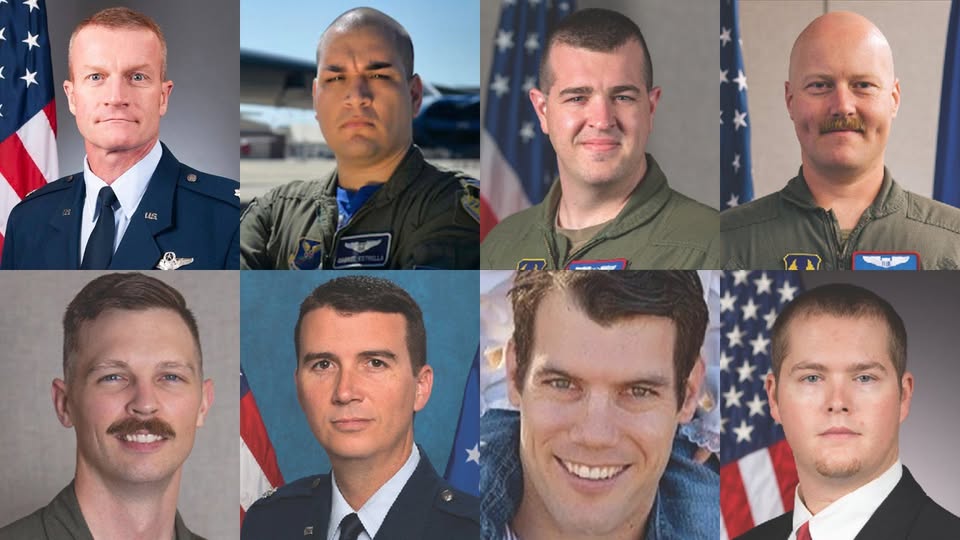
When a tragedy of unimaginable magnitude strikes the military community, the ripples of grief extend far beyond the gates of the base. We are currently witnessing one of the most heartbreaking moments in recent aerospace history. Our hearts are heavy as we process the Brad Hovey, Gregory Watson, Gabriel Estrella, Alexander Davis And Robert Dee death, obituary: Air Force identifies crew members killed in California B-52 crash. On a routine Monday morning, June 15, 2026, the skies over the Mojave Desert became the final resting place for eight extraordinary Americans. They were fathers, husbands, seasoned pilots, brilliant engineers, and dedicated weapon systems officers. This catastrophic loss at Edwards Air Force Base has left families shattered, a community in mourning, and a nation reflecting on the steep price of technological progress and national defense.
The search for answers is just beginning. As federal investigators meticulously comb through the wreckage of the B-52H Stratofortress, the rest of the world is left to honor the legacies of these eight men. You cannot begin to grasp the sheer magnitude of this loss without understanding who these men were, the critical mission they were undertaking, and the complex web of community, military, and legal ramifications that follow an event of this scale. Let us dive deeply into every facet of this tragedy, ensuring that their names, their mission, and their sacrifices are etched into the public memory with the respect and depth they deserve.
The Incident: What Happened in the Mojave Skies
The crisp morning air over Edwards Air Force Base in Southern California is usually pierced by the roaring engines of the world’s most advanced aircraft. Monday, June 15, 2026, started like any other day for the men of the 412th Test Wing and the Combined Test Force. Their mission was highly specialized but entirely routine for a crew of this caliber: a test flight supporting a massive radar modernization program for the B-52H Stratofortress. This specific aircraft, a legendary workhorse of the United States Air Force, was carrying an unusually large crew of eight personnel. It included active-duty airmen, a reservist, and civilian defense contractors—a true testament to the collaborative nature of modern military aviation.
Shortly after takeoff, something went catastrophically wrong. The massive bomber, an engineering marvel that has served as the backbone of America’s strategic bomber force for over six decades, plunged into the desert earth. Witnesses described a fiery crash that sent a shockwave through the tightly knit military community. Base emergency response teams were deployed immediately, but the sheer force of the impact and the resulting inferno left no survivors.
The immediate aftermath was a blur of protocol and heartbreak. The airfield was locked down, and operations were momentarily suspended as commanders grappled with the devastating reality. Under Department of War policy, the military initiated a strict 24-hour waiting period after completing the grueling task of notifying the next of kin. During this agonizing window, rumors swirled, and families prayed against hope, waiting for a knock on the door that would inevitably alter their lives forever. By Wednesday, Col. Thomas Tauer, commander of the 412th Test Wing, stood before the base personnel and the world to officially release the names. He called them dedicated professionals, beloved family members, and irreplaceable teammates. As investigators brace for a comprehensive probe that could take up to six months, we are left to piece together the narrative of that tragic morning and reflect on the inherent dangers faced by those who push the boundaries of aviation.
Honoring the Fallen: The Eight Heroes We Lost
To merely list the names of the deceased is a disservice to the vibrant, impactful lives they lived. Each of these eight men represented the absolute pinnacle of their respective fields. They were the brilliant minds tasked with keeping a Cold War-era bomber relevant in the 21st century.
Col. Gregory Watson, 53, lived a life defined by dual service. Operating as a weapon systems officer, he was an Air Force reservist assigned to the 10th Air Force at Naval Air Station Joint Reserve Base in Fort Worth, Texas. But his expertise extended into the civilian sector as a highly valued Boeing contractor based out of Shreveport, Louisiana—home to Barksdale Air Force Base. Watson understood the B-52 like few others on the planet. His decades of experience meant he wasn’t just operating a radar; he was actively shaping how the next generation of airmen would interact with the aircraft. Balancing the rigorous demands of the reserve forces with his corporate responsibilities at Boeing, Watson was a mentor to countless young officers, bridging the gap between military necessity and industrial innovation.
Lt. Col. Gabriel Estrella, 40, was a brilliant weapon systems officer assigned to the Air Force Operational Test and Evaluation Center, Detachment 5. The outpouring of grief following his death offered a profoundly intimate look into the life of a military family. Before his name was officially released, his wife, Brianna, posted a shattering tribute on Facebook that brought the reality of military sacrifice to the public’s doorstep. She described him as her hero, noting that this test flight was a once-in-a-lifetime opportunity he had been eagerly anticipating. Gabriel didn’t just do his job; he lived for it. Brianna recounted how he woke up every day excited to go to work, always encouraging their children to follow their dreams with the same passion. His dedication to his craft and his family paints a portrait of a man who fully understood the risks of his profession but embraced them with joy and unwavering commitment.
Maj. Alexander Davis, 34, represented the bright future of the Air Force. Another highly skilled weapon systems officer, he was assigned to the 419th Flight Test Squadron in Lancaster, California. At just 34 years old, Davis had already achieved a level of technical mastery that placed him on one of the most critical testing programs in the military. His role required an intense, analytical mind capable of processing vast amounts of data at hundreds of miles per hour. Colleagues knew him as a razor-sharp tactical thinker, someone who could troubleshoot complex avionics under immense pressure.
Maj. Robert Dee, 40, was a pilot’s pilot. Assigned to the 419th Flight Test Squadron at Edwards AFB, Dee carried the immense responsibility of manipulating a heavy, eight-engine strategic bomber through delicate test parameters. Piloting a B-52 is not like flying a fighter jet; it requires anticipation, muscle memory, and an intimate understanding of aerodynamics. Dee was known for his calm demeanor in the cockpit, a crucial trait when pushing an aircraft to its operational limits.
Maj. Brad Hovey, 35, also a pilot with the 419th Flight Test Squadron, brought his Midwestern values to the high-stakes world of flight testing. An Iowa native, Hovey’s death resonated deeply in his home state, prompting Governor Kim Reynolds to issue a heartfelt statement of condolence. Hovey’s journey from the heartland to the absolute cutting edge of aerospace testing is a classic American story. He spent years honing his skills, surviving grueling training regimens to earn his seat in the stratofortress.
Jeromy Smith, 32, was a flight test engineer assigned to the 419th in Rosamond, California. While the pilots and weapon systems officers often receive the lion’s share of public attention, engineers like Smith are the unsung heroes of military advancement. He was the vital link between the theoretical data on a computer screen and the physical reality of the aircraft in flight.
Christopher Rischar, 41, brought a decade of relentless dedication to Edwards Air Force Base. A flight test engineer and contractor with JT4, Rischar was a fixture in the Lancaster community. His wife, Rebecca, shared that they met at a church youth group in high school, building a life deeply intertwined with the local aerospace culture. Christopher was a devoted father to a 14-year-old and a 15-year-old, frequently taking them to airplane museums to share his passion for flight. In a heartbreaking twist of fate, his own father, who also works at the base, witnessed the crash.
Retired Lt. Col. Miles Middleton, 50, lived in Tehachapi and served as the second Boeing pilot on the ill-fated flight. Having completed a full, honorable career in the active-duty military, Middleton could have easily retired to a quiet life. Instead, his love for aviation and his desire to continue serving his country led him to the contractor side of the house. Married with two children, Middleton brought decades of invaluable flight hours to the testing program.
Understanding the B-52H Stratofortress and Radar Modernization
You cannot fully grasp the tragedy of this test flight without understanding the mammoth machine they were flying and the specific mission they were executing. The Boeing B-52 Stratofortress is a marvel of endurance. First flown in 1952, it was designed during the early days of the Cold War to deliver nuclear weapons deep into Soviet territory. Yet, here we are in 2026, and the B-52 remains the undisputed workhorse of the Air Force’s global strike command. How does an aircraft designed when Harry Truman was president remain relevant in the age of stealth fighters and hypersonic missiles? The answer lies in relentless, dangerous, and meticulous modernization programs.
The crew was engaged in a test flight supporting a sweeping radar modernization program. The old mechanical radars of the B-52, which have guided crews through conflicts from Vietnam to the Middle East, are increasingly obsolete in the face of modern electronic warfare. The Air Force has been undertaking a multi-billion-dollar effort to outfit the fleet with Active Electronically Scanned Array (AESA) radar systems. This upgrade is essentially akin to taking a classic 1960s muscle car and retrofitting it with the central nervous system of a modern supercomputer.
The AESA radar allows the massive bomber to track multiple targets simultaneously, map terrain with unprecedented high resolution, and operate in highly contested environments where enemy jamming would easily blind older systems. Integrating this new technology requires extensive flight testing. It is not enough to plug the system in on the ground; the aircraft must be taken to altitude, flown through specific maneuvers, and subjected to massive gravitational and electrical stresses to ensure the radar functions perfectly. This is where the brilliant minds of flight test engineers like Jeromy Smith and Christopher Rischar, paired with the tactical execution of weapon systems officers like Gabriel Estrella and Alexander Davis, became essential. They were rewriting the manual for the next thirty years of bomber operations. The risks of test flying are immense. Any integration of new avionics can affect the aircraft’s power grid, software communication, and overall stability.
Edwards Air Force Base and the Combined Test Force Construct
Edwards Air Force Base is not just an airstrip; it is hallowed ground for aerospace enthusiasts and military historians alike. Nestled in the unforgiving environment of the Mojave Desert, its massive dry lake beds have served as the ultimate proving ground since the days of Chuck Yeager breaking the sound barrier. The base is the epicenter of the Air Force Test Center, a place where the theoretical limits of physics and engineering are pushed until they snap.
The specific operational structure that the fallen crew operated under is known as the Combined Test Force (CTF). The CTF is a unique and highly efficient organizational construct designed to streamline the testing of complex military hardware. In a CTF, active-duty military personnel, government civilian employees, and defense contractors work side-by-side in a deeply integrated environment. You don’t have separate teams working in silos; you have an Air Force pilot sitting next to a Boeing engineer, communicating in real-time with a JT4 contractor tracking telemetry on the ground.
This tragic flight perfectly illustrated the CTF model. You had active-duty Air Force majors (Dee, Hovey, Davis) working alongside reservists (Watson) and seasoned corporate contractors (Middleton, Rischar). This synergy is absolutely vital because no single entity holds all the expertise needed to modernize an aircraft as complex as the B-52. The military provides the operational requirements and the combat context, while contractors like Boeing provide the proprietary engineering data, and firms like JT4 manage the specialized test range infrastructure. When a loss like this occurs, it doesn’t just impact a single squadron; it devastates a deeply interconnected ecosystem of professionals who share office space, break rooms, and the skies.
Legal Philosophy and Accountability: The Feres Doctrine vs. Civil Litigation
Whenever a catastrophic loss of life occurs, the immediate human reaction is a search for answers—and ultimately, a search for accountability. In the civilian world, massive accidents or tragic losses often trigger immediate, aggressive civil litigation. However, the legal philosophy surrounding military accidents operates in a vastly different, often highly controversial, dimension of American jurisprudence.
Central to this legal framework is the Feres Doctrine, a precedent stemming from a 1950 Supreme Court ruling. The doctrine effectively bars active-duty service members and their families from suing the federal government for injuries or deaths sustained that are “incident to military service.” While a civilian family might sue an airline or an aircraft manufacturer for millions in the wake of a crash under the Federal Tort Claims Act, the families of Maj. Dee, Maj. Hovey, Lt. Col. Estrella, and Maj. Davis face massive legal roadblocks if they seek to hold the military civilly liable. The philosophical justification behind the Feres Doctrine is that allowing service members to sue the government would undermine military discipline, flood the courts with combat-related claims, and disrupt the no-fault compensation system already provided by Veterans Affairs and military death benefits.
However, the presence of civilian contractors on this doomed flight—specifically the employees from Boeing and JT4—adds an incredibly dense layer of legal complexity. The families of retired Lt. Col. Miles Middleton, Col. Gregory Watson (in his capacity as a Boeing employee), and Christopher Rischar are not bound by the Feres Doctrine in the same way active-duty members are. Furthermore, if an investigation reveals that a manufacturing defect or negligence on the part of a civilian contractor caused the crash, the active-duty families might actually have grounds for a third-party product liability lawsuit. This creates a deeply fractured legal aftermath where families grieving the exact same tragedy have wildly different avenues for legal recourse.
To understand how bizarre and insulated the military legal framework is, one must contrast it with the way modern American society handles public accountability in high-profile civilian spectacles. When the public thinks of legal accountability today, their minds often drift to highly televised, sensationalized court battles that play out as much in the media as they do before a judge. Take, for example, the criminal trials of disgraced Hollywood mogul Harvey Weinstein. The Weinstein case redefined the #MeToo era, illustrating how modern legal philosophy has shifted toward swift, deeply public accountability where corporate complicity is dragged into the harsh light of media scrutiny. His trials were global events where public opinion demanded immediate legal retribution, dismantling a corporate empire overnight.
Similarly, look at the sweeping defamation and civil suits surrounding Rudy Giuliani. The legal philosophy driving those cases was deeply tied to public narrative, civil liability, and the weaponization of the media cycle. In Giuliani’s legal battles, every filing was a headline, every courtroom outburst was a trending topic, and accountability was demanded not just by the plaintiffs, but by an enraged public utilizing the courts as a tool for political and social reckoning.
In stark contrast, military aviation tragedies are shielded from this kind of public legal theater. The investigations are handled internally by Air Force safety boards and accident investigation boards. The findings are highly classified, heavily redacted, and methodically slow. There are no television cameras in a military tribunal regarding a test flight crash. There is no media frenzy demanding the immediate bankruptcy of the defense contractor. The legal philosophy in the military sphere prioritizes systemic correction and national security over public catharsis and punitive damages. This stark dichotomy highlights how our legal system treats soldiers and defense contractors as entirely separate entities from the civilians caught in public scandals.
Media Presence, Narrative Control, and Public Mourning in the Digital Age
The handling of the Edwards Air Force Base B-52 crash highlights the delicate dance between military narrative control and the rapid, unfiltered nature of the digital age. In decades past, a military crash was reported via a terse, carefully sanitized press release printed in the morning paper. Today, the media presence is instant, omnipresent, and deeply personal.
The military employs strict Public Affairs protocols. As witnessed in this tragedy, the base initiated a total information blackout regarding the identities of the crew until the 24-hour next-of-kin notification period expired. This policy is a vital psychological shield, preventing families from learning about the deaths of their loved ones via a push notification on their smartphones. Col. Thomas Tauer’s press conference was a masterclass in military stoicism—delivering the facts, honoring the dead, but revealing zero speculative details about the cause of the crash.
However, the military can no longer entirely control the narrative. Social media has democratized mourning. Before the official Air Force graphics were even posted on the Defense Visual Information Distribution Service (DVIDS), the digital community was already grieving. Brianna Estrella’s heartbreaking Facebook post bypassed the sanitized language of official press releases. Her raw, unfiltered expression of shattered hearts and shattered dreams resonated globally, humanizing the sterile term “weapon systems officer” for the millions of civilians who read it. Through social media, the public was granted unprecedented access to the emotional fallout of a classified test mission. This immediate, digital media presence forces military institutions to balance their need for operational security with the modern public’s demand for emotional connection and transparency.
Community Impact: The Weight Carried by Aerospace Towns
The high desert of Southern California is a unique geographical and cultural anomaly. Towns like Lancaster, Palmdale, Rosamond, and Tehachapi are not just suburbs; they are company towns where the “company” is the American aerospace complex. The impact of losing eight men in a single crash reverberates through these communities with the force of a localized earthquake.
In these communities, everybody knows somebody connected to the base. The man behind you in line at the grocery store might be a flight test engineer. The woman coaching your child’s soccer team might be an aerodynamicist. The death of Christopher Rischar is a prime example of this deep community entwinement. He met his wife at a local church youth group in Lancaster. He raised his teenagers in the shadow of the base. His father, a fellow base employee, physically witnessed the horrific accident. The trauma is not isolated to the immediate families; it is a shared, communal wound.
When an incident like this happens, the local economy, the schools, and the social fabric are all deeply affected. Spouses gather in living rooms to provide the kind of silent, knowing support that only other military families can offer. The community impact is profound because these towns exist in a perpetual state of underlying anxiety. Every time a sonic boom rattles the windows of a house in Rosamond, it is a reminder of the inherent dangers of the work being done just a few miles away. The loss of these eight heroes serves as a grim validation of that underlying fear, permanently altering the communal psyche of the Antelope Valley.
Historical Context of Military Test Flight Accidents
We cannot look at this tragedy in isolation. The history of military flight testing is paved with the ultimate sacrifices of brilliant aviators. Pushing the envelope inherently involves stepping into the unknown, and occasionally, the unknown bites back with devastating consequences.
The B-52, despite its incredible safety record relative to its age, has seen its share of highly publicized tragedies. One of the most infamous occurred in 1994 at Fairchild Air Force Base, when a B-52 crashed while rehearsing for an airshow, killing all four crew members. That incident completely changed how the Air Force viewed pilot culture and safety regulations. Similarly, a 2008 crash of a B-52 off the coast of Guam resulted in the tragic loss of six crew members, sparking massive investigations into maintenance, fatigue, and operational tempo.
Testing at Edwards Air Force Base is intrinsically tied to a legacy of danger. From the deaths of early jet pioneers like Glen Edwards (for whom the base is named) to the tragic loss of test pilots during the early days of the space race, the dry lake beds of the Mojave have absorbed the blood of countless heroes. Every single safety protocol, every checklist, and every emergency procedure currently utilized in modern aviation was written because someone, somewhere, paid the price to discover a flaw. The loss of Watson, Estrella, Davis, Dee, Hovey, Smith, Rischar, and Middleton will inevitably lead to new discoveries. The six-month investigation will yield data that will make the radar modernization program safer, ensuring that the next generation of bomber crews can fly with confidence. Their deaths are an unspeakable tragedy, but in the harsh, pragmatic world of flight testing, they are also a grim necessity for the advancement of human engineering.
Frequently Asked Questions
What caused the B-52 crash at Edwards Air Force Base? As of now, the exact cause of the crash remains under intense investigation by federal and military authorities. The Air Force has stated that the investigation could take up to six months. The aircraft was undergoing a test flight for a radar modernization program, meaning experimental integration of avionics could be a factor, alongside mechanical failure or environmental conditions.
What is the Feres Doctrine and how does it relate to the crash? The Feres Doctrine is a legal precedent that prevents active-duty military personnel and their families from suing the federal government for injuries or deaths sustained during military service. This means the families of the active-duty officers on the B-52 cannot file civil torts against the Air Force, though families of civilian contractors aboard may have different legal avenues.
What does a Weapon Systems Officer (WSO) do on a B-52? A Weapon Systems Officer on a B-52 is responsible for operating the complex avionics, navigation, and weapon delivery systems. In the context of this fatal test flight, the WSOs were likely testing the new Active Electronically Scanned Array (AESA) radar, ensuring it effectively tracks targets and communicates with the aircraft’s central computers.
Why are civilian contractors flying on military test flights? Modern military aircraft are highly complex systems developed by private aerospace companies like Boeing. The military utilizes a Combined Test Force (CTF) construct, which places active-duty pilots and engineers alongside corporate civilian contractors to streamline testing, share proprietary engineering insights, and fix software anomalies in real-time.
What is the B-52 radar modernization program? The Air Force is currently upgrading the 1960s-era mechanical radars on its B-52 fleet with state-of-the-art AESA radars. This upgrade will allow the classic bombers to “see” further, track multiple targets simultaneously, and resist enemy electronic jamming, extending the operational lifespan of the B-52 into the 2050s.
Conclusion: A Legacy Forged in the Skies
The tragedy that unfolded in the skies over Edwards Air Force Base will not soon be forgotten. The Brad Hovey, Gregory Watson, Gabriel Estrella, Alexander Davis And Robert Dee death, obituary: Air Force identifies crew members killed in California B-52 crash stands as a somber reminder of the relentless cost of freedom. These eight men—Watson, Estrella, Davis, Dee, Hovey, Smith, Rischar, and Middleton—were not simply victims of a mechanical failure. They were pioneers standing on the very edge of technological capability. They knowingly accepted the massive risks associated with flight testing because they believed in the mission, they believed in their country, and they believed in each other.
As the investigations proceed and the legal, media, and community impacts continue to unfold, we must ensure that their memories are not reduced to mere statistics in an accident report. They were the lifeblood of the Antelope Valley, the pride of the United States Air Force, and the quiet heroes of the aerospace industry. The skies are safer today because of the work they accomplished, and the massive B-52s that will continue to fly into the mid-century will do so guided by the profound legacy they left behind.